A comprehensive examination evaluates how clearly you see, how your eyes work together and the health of structures inside and outside your eyes. The exact tests vary with your age, symptoms, health history and previous findings.
Reviewing your vision and health history
Your optometrist may ask about changes in your vision or comfort, your current glasses or contact lenses, family eye history, medications and general health. Diabetes, high blood pressure, screen use, driving, reading and occupational needs may all influence which tests are most appropriate.
Measuring your vision and prescription
Visual-acuity testing measures how clearly each eye sees. Refraction testing helps determine whether nearsightedness, farsightedness, astigmatism or age-related focusing changes affect your vision.
A prescription is only one part of the examination. Someone can see clearly and still have an eye-health concern that needs attention.
Checking focusing and eye coordination
Depending on your needs, the examination may assess eye alignment and movement, how the eyes work together, near and distance focusing, depth perception, peripheral vision and colour vision.
These measurements can be particularly important for children, patients experiencing eyestrain and people whose work involves prolonged reading or screen use.
Examining the health of your eyes
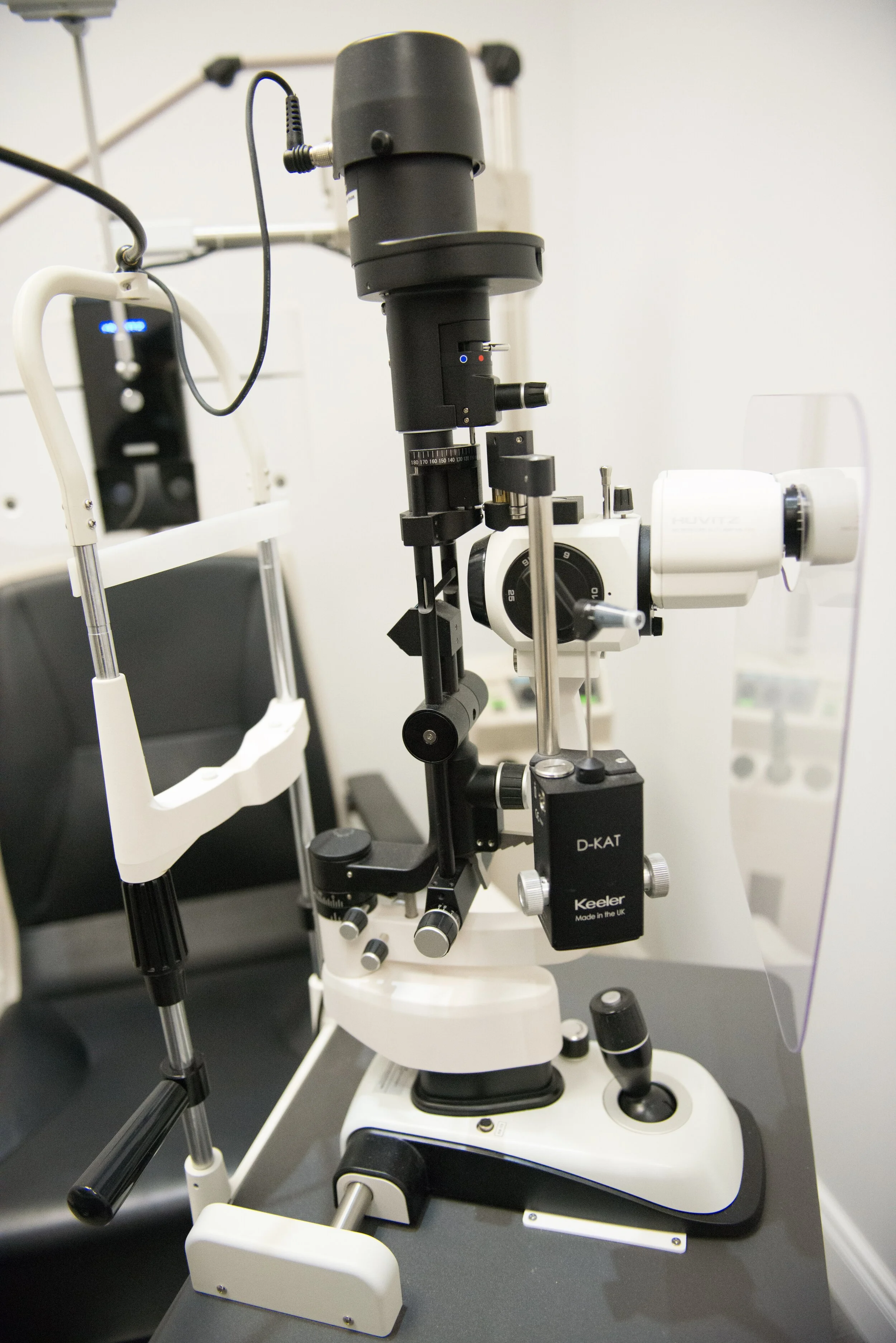
Your optometrist examines the front and back of each eye for signs of disease or injury. Testing may include eye-pressure measurement and examination of the cornea, lens, retina, macula, blood vessels and optic nerve.
Some conditions can develop without obvious early symptoms. That is why a comprehensive examination is valuable even when your vision seems unchanged.
Will my eyes be dilated?
Dilating drops may be recommended when a wider view of the retina is clinically appropriate. The drops can temporarily cause light sensitivity and blurry near vision. Bring sunglasses for comfort afterward. Everyone reacts differently: some people feel comfortable driving with sunglasses, while others find the light or blur too uncomfortable. If you are unsure how you will react, arrange for a driver, and do not drive until your vision feels safe for driving. Your optometrist will explain why dilation is being recommended and what to expect afterward.
Digital retinal imaging may also be offered to create a detailed baseline photograph. Imaging and dilation provide different information; one does not necessarily replace the other.
At RevitalEyes, digital retinal imaging is $60, or $150 when combined with a comprehensive private-pay examination.
How much does an eye exam cost?
- Comprehensive adult eye exam: $100
- Eye exam with digital retinal imaging: $150
- Eye exam with standard contact-lens fitting and trials: $135
- Eye exam with multifocal or XR contact-lens fitting and trials: $150
- First-time contact-lens teach and fit: $75
Eligible insurance claims can be submitted directly to many major insurers. Please confirm your available benefits with your insurer.
Who qualifies for an OHIP-covered eye exam?
Eligible Ontario patients may include children and youth aged 19 and younger, adults aged 65 and older, patients with diabetes, and patients with certain qualifying eye or medical conditions.
Eligible patients with diabetes are covered for an eye examination once every 12 months through their Ontario health card. Coverage remains subject to a valid health card and current OHIP eligibility requirements.
Most adults aged 20–64 without a qualifying medical condition are not covered for routine eye examinations. Read our complete OHIP eye-exam guide for more detail.
What should I bring?
- Your current glasses and sunglasses (sunglasses can help after dilation)
- Your contact lenses and lens information
- A medication list
- Your Ontario health card, if applicable
- Private insurance information
- Details of previous eye care or recent symptoms
Book an eye exam in Boxgrove, Markham
RevitalEyes Eye Care provides family eye care in English and Tamil at 72 Copper Creek Drive, Unit 104. Optometrist appointments are available Wednesday, Thursday and Saturday.
Request an appointment with RevitalEyes.
Frequently asked questions
How long does a comprehensive eye exam take?
Appointment length varies according to the tests required, whether dilation is recommended and whether contact lenses are being assessed.
Do I need an examination if I see clearly?
Yes. Clear vision does not necessarily confirm that your eyes are healthy. Some eye conditions can develop before noticeable symptoms appear.
Are diabetic eye exams covered annually?
Eligible patients with diabetes can receive an OHIP-covered eye examination once every 12 months, subject to current eligibility requirements.
Is retinal imaging included with OHIP?
Digital retinal imaging is generally an uninsured service. RevitalEyes charges $60 for imaging.
Can I drive after dilation?
People react differently to dilating drops. Bring sunglasses because your eyes may be sensitive to light for a few hours. Some people are comfortable driving with sunglasses, while others are too sensitive or their vision is too blurry. If you are unsure, arrange for someone to drive you home; do not drive until your vision feels safe for driving.
Sources and medical review: Examination information is based on guidance from the Canadian Association of Optometrists and the College of Optometrists of Ontario. OHIP information is based on the College’s funding guidance. This article was reviewed by Dr. Mathuraa Sasitharan. Eligibility and provincial rules can change; contact the clinic to confirm current coverage.